Tuesday, 5 November 2013

Basilica Construction Log 1

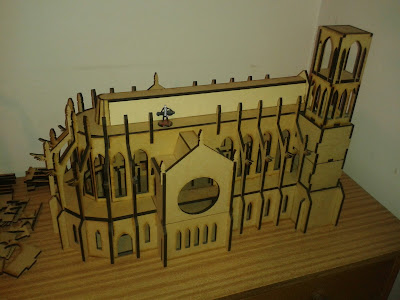
Side view (Kerberos on the roof)

I'm actually pretty close to the end of this particular craft journey, having started the planning during the 2010 Christmas holidays. I'd recently started playing the Anima: Tactics wargame, and wanted to use our work's newly-acquired laser engraver to make a spectacular piece of scenery - a basilica suitable for miniatures to run around on!

Kerberos welcomes you to the Basilica

I did the design work in Illustrator, mapping everything out in 2D and doing the 3D transformations largely in my head. I replaced all of the roof sections, which would normally be sloped, with stepped shelves. In addition, the ground floor and the upper sections would be completely separate, allowing you to play on the outside or remove the upper works to access the floor inside. The towers at the front (one still under construction) would also be modular, so you can remove each level to access the ones underneath. The towers also contain roughly stepped "stairs" for putting 30mm miniature bases on.

Front view (one tower still to be added)

I did a lot of work in the first eight months, and then after completing the bottom level I stopped working on it for a while. I went back and started the upper works, but I had in mind to put some bas relief sculptures on the facade so there were some parts I couldn't do until I found or created some suitable images. Unfortunately I couldn't find what I was looking for, so work stalled for over a year.

Now, I'm about to move away, so I'm trying to get the rest of the job done before I lose easy access to a laser engraver! I've bitten the bullet and moved on without any sculptures on the front. I figure I can paint or sculpt something later to go on the arch above the door. Today I finished cutting all the pieces for the superstructure, and did a dry fit to make sure I hadn't forgotten anything or made any errors. So far I'm very pleased with the results!

Back view

Overall, the structure is about 600mm long, 350mm wide, and 450mm tall. It's made from a mix of 6mm and 3mm MDF, with some details in thin plywood. I'll be cutting tracery railings and window inserts from plywood, but I still have to finish designing those. Ideally I'd like to sandwich coloured cellophane between two layers of wood for the windows to create a stained glass effect.

View through the front door

The transepts have removable bridges and roofs too, so characters can run from one tower all the way along the side, around the back, down the other side, and into the other tower. I designed the height of various levels with Anima characters in mind, so the lower floor is 4 inches tall (an average character's jump height), and the distance from the balcony to the edge of the roof is 6 inches (a fast character's jump height).

I'll update again when I have some new developments.

Thursday, 31 October 2013

To Kickstart or not to Kickstart?

I'm hoping to get the PowerFrame core rulebook squared away early next year, and have it ready to release commercially. I'm looking into options, and seem to be at a bit of acrossroad: do I Kickstart it, or just put it up on DriveThruRPG when it's ready to go?

There aren't all that many reasons for me to run a Kickstarter that I can see. It would be nice to have an up-front lump sum so I can afford to spend some quality time finishing off the document, and it would be pleasant to get a return on the capital outlay I've made on Adobe CS software over the years. And it might give me an idea of how much interest there is in the game, which would be a useful gauge - do I keep writing and developing things for it, or should I move on to something else? Kickstarters also tend to garner quite a bit of attention and publicity, and I would probably access a wider audience of potential customers than through my current social media channels.

On the flip side, I'm not planning on doing an actual print run. If anything, physical copies will be print on demand. Apart from that, I don't want to complicate a Kickstarter with physical rewards even though custom dice would be cool. And even if nobody pays me a cent, I can keep working away on the document in my spare time until I'm happy to release it. Kickstarters also demand a fair amount of effort to simply run the campaign, and there are logistical considerations such as taxes to take into account. I'm not entirely sure I have enough on offer to actually raise a decent amount.

So my other option is to work on the game until I'm happy with it, and then simply publish it on DTRPG for PDF and POD sales. I would then promote it through my various channels, and probably generate a small volume of sales in the "long tail" model. I could also develop and release additional material if and when I develop it, without being beholden to Kickstarter deadlines.

So, opinions? For a game that's almost finished, and for which my production costs (apart from prior investment in software) are negligible, is it worth running a Kickstarter? Would it simply be easier and just as good in the long run to just publish it on DTRPG?

Saturday, 12 October 2013

Rippers: Prologue

Since our D&D Next DM's on an extended holiday, a few of us from that group decided to get together for a game in Savage Worlds' "Rippers" setting. I'm GMing; there were going to be three players, but James wasn't able to make it for this first session.

Michael had made his character ahead of time, but Annette had been otherwise occupied. We started work shortly before Michael arrived, and managed to get her character organised after a couple of hours. Although she enjoys roleplaying, she's expressed a dislike for character creation, so we discussed the issues around that a bit. Character creation in some games can be a bit of a slog, and while Savage Worlds is not quite as convoluted as the current D&D Next, it is up there a bit. The need to have a good grasp of the available Edges is probably the biggest hurdle to overcome. I've also found that, instead of buying Edges and Hindrances near the end, character creation in Savage Worlds is usually best done by starting with the Edges you want and then buying Attributes and Skills afterwards to ensure you meet the Edge requirements.

Annette explained that she dislikes the process of trying to find the right way to express her character concept in game terms. It's one thing to describe them in prose, but another thing entirely to translate that into numbers and game options. "If you want your character to do X, you have to take points in Y" was just not engaging or exciting for her. The pitfalls of the concept-to-mechanics process were also made abundantly clear when Michael's professor of archaeology turned out to not actually have the Knowledge (Archaeology) skill - an omission that was rectified in play by swapping out one of his other skills. The need to manipulate multiple interacting segments takes a certain amount of concentration; not only do you have to know which Edges to take, but Attributes are affected by Edges, and Skills are affected by both Edges and Attributes.

Character creation is often seen as a chore - a necessary evil that needs to be suffered in order to get to the fun bit. Mind you, some people do actually enjoy the character creation process itself, although that probably depends on the game. I talked a bit about some of the other games I'd run lately that approach character creation somewhat differently. Apocalypse World (and the *World games in general) give you a guided package deal where all of the thematic choices have been compiled for you, so you just need to go through a checklist and pick some stuff that sounds cool. Some games such as Fiasco and Annalise build character creation into the session itself. Annalise also starts with very vague character outlines which become fleshed out during play, while Fiasco defines characters only by their relationships and requires you to hash out a consensus of who these people are in freeform discussion before the game proper gets underway. In Fate, a high concept aspect such as "Disgraced Professor of Archaeology from Cambridge" would tend to avoid the problem of forgetting to buy all the mechanical widgets to suit your concept, although Fate still has Skills and Stunts to select or build.

During the session Annette also mentioned that she didn't mind spending Experience Points to buy more things for her character; it's just the huge lump of character creation that's a bit much to deal with all at once. I suggested a system (like Leverage or one suggestion in Fate) where you start out with little more than a broad character concept and then fill in the details as they come up in play. "Oh, we have to get away? Well, it turns out I'm a stunt driver! And I can hotwire this car!" It's something I might look into using heavily in a future game.

Anyway, on to the Actual Play!

  • Annette plays Gregory Pratchett, an alienist with a gift for physically battling the forces of darkness. His encounter with a werewolf led to the Rippers showing an interest in his talents.
  • Michael plays William Baker, a Professor of Archaeology who uses knowledge as a weapon. On his expeditions across Europe he began uncovering signs of the occult. In Eastern Europe, one of his parties was all but wiped out by a vampire. He was kicked out of Cambridge for publicly airing his views on the supernatural, losing his tenure and his marriage. The Rippers recruited him shortly afterwards.


The two recent recruits to the Rippers' London Lodge meet briefly with Johann Van Helsing himself. He welcomes them to the organisation, and immediately provides them with a mission. The Rippers' information network had picked up news of a disturbance at Canary Wharf. It sounds as though it might be Cabal-related, but the Rippers don't have any definite information yet. The pair are sent off into the foggy London night to see what they can discover.

Thick fog rolls across the dockside warehouses. On the other side of the street, the wan light from a tavern is the only cheer to be seen in the gloom, but the place does not boast the raucous sounds normally heard from such common establishments. The pair make their entrance to find the bar nearly empty, with only the innkeeper and a few sullen workers nursing their drinks. A group of three are gathered near the back, two men comforting their obviously shaken comrade - Alf, the man who had been attacked.

The overdressed Rippers interview Alf, gaining his confidence with drink, coin, and encouraging words. He tells them that he was working in one of the warehouses when a long, narrow crate burst open, smashing him in the head with a flying plank and knocking him to the ground. He was dazed, but recalled the scent of roses and had the vague impression of a form shambling away. By the time he came to his senses, his mates had come to assist and drag him away. The men refused to return to work, much to the chagrin of their boss, so the wharves have lain idle since late afternoon. The men aren't sure where the ship that carried the crates had sailed from, but believe it had come through the Mediterranean. Pratchett and Baker ask if Alf will show them to the site of the incident, but no force will motivate him. His friend George, however, is eager to help.

Baker manages to jimmy the lock on the gate, and they enter the docks. George leads them between rows of warehouses. The eerie silence is broken only by the noise of movement some distance to their right, but they ignore it and press on to the warehouse where the incident took place. The storage area stands unchanged since the afternoon, with a devastated crate on the floor and stacks of them against the wall. Baker discovers a scrap of dried cloth in the ruined box, which smells vaguely of perfume and dried herbs. Pratchett breaks open one of the other crates, and discovers a mummified corpse nestled beneath the packing straw! The sound of rattling chains from the front gate cannot deter them from their investigation, and they are loath to go see what it is in case they disturb some night-watchman. Pratchett runs the corpse through with his sword-cane to test it for signs of animation, but it appears to simply be a dry husk. They search for clues as to the crates' origins, but find only a cargo lot number stamped on them.

They hear a strangled scream from the street, and finally call off their investigation to rush to the front gate. They see a drunk man sitting against a lamp-post with his neck at a fatal angle, and catch sight of a stiff form shambling away into the fog. They pursue it, and the figure turns to confront them - a mummy, risen from the tomb, with blazing green eyes. It prepares to attack, but Pratchett speaks to it in Ancient Egyptian and persuades it that they have been sent to help it in its task. In a dry husky voice it hisses "the Eye of Osiris" and motions for them to follow.

Their undead friend leads them through a series of back alleys, thankfully sparing them from any more run-ins with the public. However, it becomes apparent that the mummy's destination is a soiree at an inner-city town house. They try to persuade it to wait until the party is over, but its master compels it inexorably towards its goal. Since they can't deter it, they are reluctantly forced to fight it. Pratchett whips out his sword-cane, and Baker attempts to put a couple of ruonds in it from his pistol. The mummy tries to shrug off the attacks and make for the garden wall, but Pratchett pursues it and stries it down. As it falls, it crumbles into a pile of dust and bones. Pratchett is unimpressed, as he was hoping to keep it as a pet. Baker Rips some powdered bone from the crumbled corpse to turn into extracts.

The pair gatecrash the party to attempt to gain control of the Eye of Osiris, but just as Baker is about to make an announcement to clear the crowd he spots Johannes Van Helsing among the guests. Van Helsing heads for a side-entrance, and the two wayward Rippers take this as a cue to withdraw, encouraged by the doorman. Before they can be escorted off the property, Van Helsing catches up with them and sends the doorman away. They move to a secluded garden courtyard, where they debrief Van Helsing on the mummy and the Eye of Osiris. Van Helsing explains that the party is being held by his associate, a minor aristocrat who is an avid collector of Egyptian artefacts. He will investigate the Eye of Osiris personally, and instructs the two Rippers to return to the Lodge, get some manpower, and return to the wharves. He also expects a full report in the morning.

Unfortunately, by the time they return the site has been cleared. There's no sign of the dead man or the crates of mummies. Even the broken crate has been cleared away. Their investigation frustrated, they return to the Lodge, where Baker creates two extracts from the mummy's remains.

>>> Chapters 1 to 3

Sunday, 6 October 2013

Ongoing Development

Here's a review of the development work I've been doing lately on my games Neon Burn and PowerFrame.

Neon Burn

For the last couple of weeks, since the Neon Burn playtests, I haven't been doing much actual writing. Instead, I've been letting some ideas about Neon Burn percolate through my brain. They are just about at the point where I can consider putting together a revised framework for the game.

So to recap, the main issues I found during the playtests were:

  • Awarding Sparks to players when they portrayed their characters' Passions felt like a cheap bribe, and led to some undesirable "button-mashing." Since Passions don't change much, I also get the feeling that this would lead to repetitive sessions since you can always be rewarded for the same things.
  • Talents weren't enough to keep people engaged during the Event. They simply didn't take much mental effort, and from the amount of Sparks we had, there was no incentive not to spam them whenever they made sense - so, no tactical decision-making.


Taking out the Passions > Sparks > Talents pretty much guts the core of the Build-Up, and also leaves the character creation process a little bereft. Therefore, something else needs to take its place. Here's what I have so far:

  • Characters
    • Roles still exist.
    • Talents may change into a single Special Ability for each Role, or maybe a choice from a limited list.
    • Sparks have currently been removed; instead, Talents may have some other restriction on their use. They may be reintroduced somehow.
  • Scenes
    • The Lead can flexibly define their own mechanical goal for a scene by declaring what they hope to increase, and what they are willing to risk losing. The Gain and Loss elements will combine to determine the Difficulty and Width for the roll.
    • The Lead will also need to frame the situation to explain how it makes sense. For example, trying to increase Performance at the risk of losing Sponsorship may be because the vehicle modification might require the team to remove parts supplied by a particular sponsor, or add parts supplied by a competitor.
    • Gains on task rolls add to the Tension Pool, which replaces the old Challenge Pool.
  • Tension
    • If left unchecked, Tension will add to the Field, making the Event harder. Tension can be reduced in a number of ways:
      • By introducing Complications that make rolls harder;
      • By introducing Stakes that are resolved depending on the outcome of the Event;
      • Possibly by introducing or resolving Drama between the player-characters. I've yet to figure out exactly how that would work, mechanically speaking.
    • Perhaps Sparks will come out of resolved Tensions somehow.
  • Motivations
    • Instead of multiple Passions with their own Burn ratings, each character will start a session with 1 Burn, giving them 1 die to roll.
    • When a potential Motivation comes up during a scene, players can claim it by writing it down.
    • Each Motivation that's relevant to a situation grants 1 Burn, adding an extra die to their pool.
      • Perhaps limit this to three Motivations of any kind, and up to an additional 3 that have Stakes attached?
      • Perhaps the prize on offer will tend to count as a Motivation attached to a Stake?

That's most of the structure so far. It's a little looser than the previous version, but I like the freedom that gives player in defining what a scene's about, and what gets their characters fired up. I've realised that there's an advantage to leaving a "fruitful void" for the players to fill in.

At the moment, the role of Sparks is uncertain. Perhaps if they're only generated in small quantities through dealing with Tensions, they might still make a good power-source for talents. +Nathaniel also suggested using them to assert authorship over certain elements or to define outcomes; given the fairly loose control the Lead has over the narrative, and that anyone else can already suggest stuff, I'm not sure if it's necessary. Perhaps if Sparks were still flowing in large quantities, they could be used to "pay" for new fictional elements or narrative control or something.

As far as keeping people engaged during the Event, it looks like the best way to do that is to give everyone a dice pool to manage. The basic ones are of course the Team's Vehicle and the Field. In addition, any Rivals were introduced during the Build-Up make for obvious candidates. There are a couple of options for any "left-over" players:
  • Introduce additional Rivals; perhaps not major ones like the story-defined Rivals, but a sort of baseline competitor, maybe with a custom Vehicle.
  • The Field could be split into more than one pool. I'm not that fond of this approach, since the Field runs pretty much "blind" and sets the basic competitor difficulty.

The main issue with having players run Rivals is that controlling them while still wanting your own Team to win is a conflict of interest. Players could make poor tactical choices for the Rivals and leave them at a disadvantage. Because of that, I need to come up with some basic "programming" for them to ensure they behave like they are trying to actually win. The basics of NPC racer programming are:
  • Start with their highest Gain, and assign it to the Width slot that has the highest other result in it that it will beat.
  • Repeat this process until you run out of Gains or Width, or until none of your remaining Gains can win any slots.
  • If you can place dice to create matches and eliminate someone else's Gain, do so by favouring matches to Vehicles with the best Position, or that will result in a Gain for a Vehicle in a worse Position than the one you're cancelling.
  • If you still have Gains to assign but they can't win or cancel any slots, just put them wherever you want.


PowerFrame

Also this weekend, I realised that I don't have an awful lot left to do on my PowerFrame generic RPG. I've been filling in some of the details and scratching things off my to-do list. The main areas remaining are:
  • I need to write the "How to run PowerFrame" chapter.
  • I need to finalise the Magic chapter and decide whether I want to include as many Spells as I can, or strip back the list to the basics and put the more esoteric Spells in a PDF supplement.
  • I need to create a whole lot of illustrations and diagrams.

Altogether it looks like it's coming along nicely, even though I've spent a lot of time questioning the way the game works on the most fundamental levels. But my friends and I have played and run it for over fifteen years in one form or another, and even though I've tired of it lately, it's still the closest it's ever been to a finished product.

I'll probably release a pretty comprehensive bestiary as a separate PDF, because the creature statblocks will take up a fair amount of space and I don't want the core-book to bloat too much. I'll be including several pages of example creatures to use as examples, but it's largely meant to be a toolbox game where you can develop your own content. 

I guess the Spells are an exception to the toolkit mentality, though, since the core of a Spell is an atomic exception-based mechanism that causes a specific effect. Each of these "Major Arcana" need to be spelled out, and the process of creating your own is not rigidly definable.

Rather, the Spells themselves are versatile because you can combine the Major Arcana (the "what" of a Spell) with various Parameters (the "where and when") and Minor Arcana (the "who") - as described in a previous post on the subject.


So, things are going reasonably smoothly at the moment. I'm going to be moving house at the end of the year, and I hope to have a few employment-free months of domestic bliss that I might be able to use to get these games into publishable shape.

Wednesday, 2 October 2013

Advertising

This is just a quick note to let my readers know I'm about to activate banner ads on this blog.

Normally I dislike online advertising, so I hope you'll appreciate this isn't a decision I've taken lightly. I'm preparing to move cities so I can live with my partner, but at the moment I have no job waiting for me there. I'm attempting to secure some additional revenue sources so I can support myself for longer.

Now it may turn out that the ads are just too annoying, or that the income they generate isn't worth the trouble. I am definitely hoping I can focus the content to gaming-relevant stuff that my readers might actually be interested in. However, I won't know any of that until I try it.

If the ads have a negative effect on your reading experience, please do let me know.

Thanks for your patience and understanding!

Sunday, 22 September 2013

Neon Burn Alpha Tests 2 & 3

In the last week I've held two Neon Burn playtest sessions online; one by audio-only over Skype, and one over G+ Hangouts. In both cases, we used a spreadsheet to track shared game information.

I'm not going to write up a full "actual play" of either session, as the point of the playtests is more to figure out where the rules function as intended and where they need work. Here, though, is a brief summary of the two games.


Pax Suprema

In a Roman Empire that never fell, lethal races are held between living brass steampunk flying machines powered by the hearts of fallen heroes, known as Bronze Lions. We established that this single-race event, the Pax Suprema, was a tournament in which only the winning team would emerge victorious - all of the losing teams would be executed on the sands of the arena. Our team was made of gladiator-slaves, racing for the glory of our Master and for our own lives.

  • +Nathaniel Robinson played Vatiatus the Champion of Neo-Kapua, a proud gladiator-racer (Driver/Gunner)
  • Luuk Mouton played Sellularius the Cheap and Lazy, a man enslaved to pay for his gambling debts (Mechanic/Dealer). 
  • I played Trixus the Scar-Crossed, a grizzled ex-gladiator (Coach/Pit-Crew)

We started off with a vicious ram installed (Chain-Blades), but spent most of the session acquiring and installing a cannon that would fire gladii at our rivals (Autocannon). Our chariot was also heavily tweaked for speed above all else.

During the race we quickly pulled away from the pack, and only broadened our lead as the race went on. By the end, we achieved a clear victory, thus ensuring the glory of our Master and sparing our own lives.


Neo-Rio Invitational

In a bright and hopeful high-tech near future, the weaponised Formula Sigma league races sleek angular antigrav vehicles all around the world. The Neo-Rio Invitational is an exhibition race, held at night on a transparent neon-walled track that loops around Rio de Janeiro. The final stages of the course spiral up the Sugarloaf Mountain and launch a jump to the finish line off the shoulders of Christ the Redeemer.

  • +Cavin DeJordy played Kael Sundar, reckless hotshot driver (Driver/Gunner).
  • +Chris Stocker played Hans Gnuuden, a retired driver turned coach (Coach/Pit-Crew)
  • +Lloyd Gyan played A.B.I.un, the A.I. installed in the vehicle (Mechanic/Copilot).
  • I played Meryl M., an enthusiastic mascot/track girl but also an able bodyguard (Publicist/Security)

We started off with a Carcatcher ram and a Mine dispenser installed, but really wanted to acquire an Energy Shield. Kael identified an old rival, Inara, in a bar, and established an Afterburn of the desire to beat her in the race. Although none of us were Dealers, we managed to get hold of an Energy Shield for the standard price. In the second-to-last scene, A.B.I. managed to install it single-handedly despite the complexity of the task, boosted by the team's desire to win and some encouragement from the sidelines.

During the race Kael quickly shot to the head of the pack. Our energy shield was invaluable, absorbing multiple attacks over the course of the race and allowing us to concentrate on gaining position. A.B.I.'s copiloting skills also helped evade any attacks that got past the shield, with Hans' pit-crew supervision standing by in case of serious need. By the time Kael hit the finish line, we had a comfortable lead over Inara (who was nursing a beat-up vehicle around the track) and the field was well behind.

Analysis

+Cavin wrote his own blog review of the Neo-Rio playtest session if you'd like to see an outsider's first opinion of the game's current draft. Below are my thoughts and musings, mostly identifying areas that worked well and those that could use improvement.

So far I've had mostly positive feedback from the players, and everyone's said they enjoyed playing, so that's encouraging me to press on and fix the problems so it can become the game I want it to be.

Session Time

I'm a little concerned about fitting the game into a three hour slot. For both playtests we basically had an hour each of Approach, Build-Up, and Event.

The Pax Romana game was really rushed at the end because we had to wait multiple "scenes" before our purchase was delivered. That led to us trying to cycle through scenes as fast as we could so we actually had time to install the weapon, which meant characterisation suffered. That was also a problem in my initial playtest, so I've removed the delivery time altogether; Add-Ons are now available at the end of the purchasing scene.

There were things we didn't get anywhere near doing in either test, such as Qualifying. Both tests also only ended up with two Afterburn out of three. However, since we spent about an hour on making the world, the characters, and the vehicle, I suspect this problem would largely go away after the first session since you'd get 1.5 to 2 hours for scenes instead of a cramped 1. Therefore it's probably simply a matter of attempting to streamline the Approach (League, Team, Vehicle) as much as possible, and adjusting expectations about what's achievable during the Build-Up. The Event is still going to need an hour the first time, even using a shorter course, because people will be getting to grips with the racing rules.

I really need to do a full-session test with multiple players face to face, and also try a two or three session League. I think the the race in particular will be much easier when you're sitting around the same table and can physically pick up and move the dice. Entering the values into a shared spreadsheet was functional but slow.

Referee

In the Pax Romana game, we assigned a Lead and a Referee to each scene. However, figuring out who was who took a little while, and by the end of the session it had become apparent that the Referee position was probably unnecessary. While they were charged with assigning NPCs for people to play, introducing Complications, and awarding Sparks, in practice we ended up distributing those responsibilities among ourselves. Luuk even framed a scene for his character which included a complication right off the bat, which I thought was cool.

For the Neo-Rio playtest, I'd written the Referee out of the rules. I didn't miss the position; we still managed to introduce Complications and set one-another up to play NPCs, and with everyone on the lookout for other players using Passions the distribution of Sparks worked well too.

Lead

With the position of Referee gone, the Lead pretty much became the GM of their own scenes. Lead choice was based on the player with the fewest Sparks, since that would give them more opportunities to generate more Sparks and catch up.

In practice +Chris came out of the first scene with a large number of Sparks, and since he gained some by being in other players' scenes while some of us were spending Sparks for off-track performance, he never ended up framing a scene of his own.

I'm considering some alternatives to make sure everyone gets a chance to have creative input and decide what's important enough to frame a scene around. I could just go with a simple turn-taking order where we go around the table, which definitely makes sure everyone gets a fair go. However, with the way some scenes are required before others (such as getting the Dealer to make a purchase before the Mechanic can install a new Add-On), I think a more flexible system is warranted.
  • One possibility would be to have the current Lead choose the new Lead at the end of their scene, from among those who have an idea what they want to do next. This may or may not also use tokens to make sure everyone has had a turn before going through the group again.
  • Another possibility would be to ask which players have an idea for a scene, and then vote on which will become the new Lead. I think that might take a little too long, though.
  • A third idea would be to have the responsibility for scene-framing go around the table, but when it's your turn you can nominate anyone as the Lead (including yourself) and frame a scene for them. This would make sure everyone gets to offer some creative input, but is also flexible enough that you can make sure important things get done even if they don't involve you. It might result in awkwardness though, if you have a scene framed around you that you don't really want.
Passions and Sparks

I'm not sure if I'm entirely happy with the use of Passions to earn Sparks. It's based on Tenra Bansho Zero's Aiki awards, but it occasionally feels a little "dance for your reward, player!" It's also a little awkward to award online, and might work more smoothly around an actual table.

The Passions themselves worked okay, once I realised the divide between "Passions used to give me dice on rolls" and "Passions used to provide Sparks."

The number of Sparks is currently also an issue. Until I ran a couple of tests, I had no real idea how many might be available for the race. As it turns out, 5 to 7 per player seems about average. With each use of a Talent requiring one Spark, at the moment there is no challenge. Any problem can be overcome by spending heaps of Sparks on it, and players still usually have several Sparks left over. 

The effect is compounded by the fact that multiple players have their own supply of Sparks, and they are all being spent on the same Vehicle to achieve victory. I'd rather there was some threat of scarcity, so you had to consider whether now is the right time to use your Talent, rather than just how many Sparks you need to spend to make the problem go away.

I've had a couple of ideas for reining in Sparks:
  • Limit the number of Sparks a player can hold at once, or limit the number that the team as a whole has access to (drawing from a central pool of 10 or 12, for example). The second option would scale nicely for different group sizes, too.
  • Increase the number of Sparks it takes to activate Talents. This could simply be a linear cost (2 or 3 per Talent instead of 1 or 2), or each Talent might have its own unique Spark cost between 1 and 3, or maybe the Spark cost during the race increases: the first use of a Talent costs 1, but the next costs 2, then 3, and so on. That wouldn't line up with the costs before the event, but it would result in escalating tension and discussion about what's really important.
Engagement During the Event
This is one area where the current draft isn't delivering. I originally wrote Talents with the idea that they would give all of the players something to do during the Event. The Driver would drive, someone would roll for the Field, someone else might roll for a Rival, and anyone else would offer input from the sidelines and look for opportunities to use their Talents.

Unfortunately, it doesn't quite work out like that in play. In the Neo-Rio race, three of us had the Vehicle, the Rival, and the Field, but the last guy didn't have much to do - and even worse, most of his applicable Talents were overshadowed by better ones from elsewhere. The huge quantities of Sparks didn't limit usage, so we never had to go for a choice of "use this one or that one?"

Talents don't require constant engagement, they just need you to stay alert for any triggering conditions.

In the post-game discussion, the idea was floated of having all of the players roll dice for something during the Event. This could be achieved by creating more Rivals, or perhaps having a sort of lesser rival which might be upgraded if you choose to pick a specific Rivalry Afterburn with them. It might also be possible to subdivide the Field into multiple pools.

However, in a cooperative game, all of the Rival and Field pools would need to place their results by some sort of formula to make sure the players controlling them don't make poor choices to help "their" Team win. I have a few ideas for automated Rival behaviour, so I'll run some tests and see how it functions.

Competitive Play

Another option was the possibility of redesigning the game for competitive play. In this approach, each player would basically represent a Team of their own. They may have friendly or not-so-friendly rivalries, relationships, and history with the other teams; they may form alliances, or be implacable enemies.

Unlike the cooperative game, players would not have a conflict of interest in playing their best and trying to win. The competition would be fierce and intense because you're playing against other human minds, and each has the same mechanical potential to bring to bear. Sorting out the results of multiple dice pools would add more depth of strategy as well. With everyone running their own vehicle, everybody would be fully engaged during the Event.

Turning it into a competitive game also removes the need to have a Challenge Pool that artificially inflates the Field if you don't cause trouble amongst yourselves. People would already have motivation to interfere with each other.

The only reason I shy away from a competitive angle is because it sets up winners and losers within the group. People who can't play the racing mini-game as well may feel dejected if they keep losing. However, over a League I could introduce different progress tracks for winners and losers. Those who lose might get a mechanical boost next time, or deepen the strength of their rivalries or something. Winning makes you soft; losing makes you hungry.

A competitive approach would require a complete rewrite of the front-end, although the racing system could remain largely as-is. Even if I don't decide to adopt this approach officially, I'm strongly considering writing it up in parallel to the collaborative game just to see how it works and what its problems are.
Monday, 9 September 2013

Fiasco: The Ice

Barb, Rohin and I got together for our first game of Fiasco. We were going to have a fourth player, but he unfortunately had to cancel. The other two hadn't read the book, so I acted as facilitator.

The Setup

After a bit of discussion, we chose The Ice Playset, situated around McMurdo Station in Antarctica. After rolling dice and choosing details, we ended up with the following relationships:
  • Barb and Rohin were "the ones who found the body," and shared the seal research camp on sea ice, out on the Weddell Sea.
  • Barb and I were ecological extremists, and shared the need to get laid in exchange for something we need.
  • Roh and I were Search & Rescue volunteers, and shared five kilos of explosives and a detonator.

It took a little while to figure out the specifics and solidify our characters. Trying to tie things together and have stuff make sense was a bit of a challenge for first-timers with no real idea how things would play out, and to be honest I got pretty frustrated at one point because I felt a responsibility to keep things going but my brain was grinding to a halt. Luckily we started getting a few good ideas into the mix, and sorted it out eventually. All up, I think the Setup took us a bit over half an hour.

The other two picked their names first, so I had to pick a name that started with "Ja-" as well, just to make this Actual Play more confusing. :P
  • Barb plays James Edwards, a young student researcher and animal activist.
  • Rohin plays Jack McReedy, a Search & Rescue volunteer.
  • I play Jane West, a PETA extremist who's undercover as a scientist.

Act One

I outlined how we took it in turns to be in the spotlight and either Establish or Resolve scenes, although the rules didn't say who got to be spotlit first. After looking at the details on the table, Barb eventually came up with the idea to frame a scene focussing on Jack and James discovering "the body." Off-screen, we decided that Jane had probably killed a Marine with an ice-pick for abusing one of the seals.


Seal researcher James discovered the body of a US Marine lying face-down on the ice. He'd got as far as going over to the body and noticing blood, plus a canister of explosives, when Jack came upon the scene. Although James wanted the explosives for his eco-extremist activities, Jack used his position as S&R team member to take command of the body and equipment. Jane showed up soon after, and helped Jack move the body and gear back to base.

Jack and Jane take the body back to an empty shed on the edge of Mactown. Jane takes the explosives, ostensibly to return them to the military, but Jack keeps the detonator.

Later that night, Jane shows up at Jack's room and seduces him. While they're in the sack, she reaches down and finds the detonator in his jacket pocket. Jack notices her taking it and they argue about it; she convinces him she just wants to "blow some stuff up" and he thinks she just wants to blow off some steam by making things go boom. So now Jane is in control of five kilos of explosives and a detonator.

In the mess hall, James has a quiet word to Jane. She tells him about the explosives, and wants to use them to cripple the base. She wants to stop humans from coming to Antarctica and spoiling its purity, and if that means dooming them all to an icy death for the sake of the animals, that's a price she's willing to pay. James convinces her that the authorities will rebuild damage to communications or the airstrip, and that they need to send a clear message that it's because of the animals, by blowing up the seal research camp. Jane agrees, so long as they can conduct an ecological assessment and make sure the explosion won't negatively impact the seals.

Meanwhile, Jack visits the doctor who's performing the autopsy on the dead Marine. The doctor determines the cause of death to be a blow to the back of the head from an ice-pick.

Jane heads out on the ice with the explosives via skidoo, to conduct her ecological impact study. However, the camp and the ice is swarming with Marines searching for clues about their murdered colleague. They question her and refuse to let her anywhere near the camp, so she speeds back to Mactown. Panic starts to rise, as she realises the investigation will likely close in on her. She needs to act fast before she's busted and loses her opportunity!


The Tilt

Barb and Rohin got to inject a couple more elements into the story. We got "A stupid plan, executed to perfection" and "A sudden reversal (of status, fortune, sympathy).


Act Two

The military investigation gets underway. James is taken to a small, clinical room and interviewed. He points the finger at Jack for taking the explosives, which are still missing. The Military Police advise James not to leave town.

The MPs turn up at Jack's quarters. One questions him while the other searches through his stuff. Jack points the finger at Jane, who was supposed to have returned the explosives. However, it looks like Jane's already pulled a fast one on him - the soldiers find the bloody ice-pick among his things, and he's placed under arrest.

On her return from the ice, Jane's desperate. She gives four kilos of explosive and the detonator to James, telling him to go out to the camp and wait until her distraction pulls the soldiers away so he can blow it up. She makes an IED out of the remaining kilo, dangerously rigged with a car battery, and throws it over the military compound's fence into a pile of diesel barrels. Miraculously she pulls it off, and the explosion creates a massive cloud of black, greasy smoke. 


I interpreted "A stupid plan, executed to perfection" to mean "I can't believe that actually worked." Barb thought it sounded more like a stupid plan should be executed perfectly stupidly, but hey.


The soldiers withdraw from the seal research camp, so James moves in and plants the bomb. Unfortunately, he runs into a couple of Marines who were left behind, and has to flee! The soldiers are caught in the explosion, and the ice shelf breaks off and starts to drift away. James is stuck on the new iceberg.

Unbeknownst to James, Jack was actually in the camp at the time, too. The two Marines had escorted him there so he could show them the murder site. He was on the other side of some crates and got caught in the explosion, but just got banged up and was also stuck on the ice with James.

Jane flees on foot across the icy wilderness, hoping to make it to a nearby French base. She miraculously evades the Marine search parties and manages to successfully flee Mactown!


The Aftermath

James (White 9): As a minor (17 years old), he came out of the situation relatively unscathed. He returned to the States, where a few years later he was imprisoned for suitcase-bombing a cancer research clinic.

Jack (Black 6): Arrested for the murder, and probably the bombing too. He returns to the States where he gets to stay in prison for a very long time. Ironically, the guy who wasn't guilty of anything paid the price for everything.

Jane (White 1): Although she made it away from McMurdo, she didn't quite make it to the French station. Somewhere in the blinding white, she falls face-down and never gets up. She's discovered a couple of years later, one arm protruding from a snowdrift.


The End!

Once we got over the initial creative hurdles and into the swing of things, it was a pretty fun game. Barb did note that it seemed like the sort of "party game" that might do better once people have had a couple of drinks to loosen things up a bit.

The game rules don't seem to come into contact with the story much, mainly just when you choose white or black dice to suggest a positive or negative outcome for a scene. Apart from that, the rules are mostly a set of procedures for creating story elements and deciding who's in charge of framing and resolving scenes.

The story elements have no mechanical weight, though; they're more like evocative springboards for the players to gain inspiration from. The system as a whole requires strong player buy-in to the type of story it wants you to create, because if people don't play towards an unmitigated disaster then the Aftermath results will likely not make much sense.

However, with people who agree what sort of story they're producing, human ingenuity and imagination seems more than capable of connecting the dots and coming up with explanations for the end results. I suppose it works as well as it does largely because everything in a playset is geared towards helping you create this sort of outcome.

Oh, and I'm sure there would be different group dynamics with four or five players. I was impressed with Relationships and Details not belonging to one character, but creating a connection between two characters. While in theory you could play out a nice, civil story of people behaving reasonably and negotiating for what they want, the nature of the relationships and details on offer do tend to create situations in motion where some of the wheels are almost guaranteed to come off in play.